
#131- What SpaceX actually changed
How one company rewired the economics of space
SpaceX’s IPO was one of the largest wealth creation events in modern history.
The company closed at a valuation exceeding $2 trillion. It made Elon Musk the world’s first trillionaire. Thousands of current and former employees became millionaires. Hundreds became centimillionaires. A couple even became billionaires. Most commentary has focused on the valuation, the adulation or the absurdity of it. I think that’s the least interesting thing about SpaceX.
The more important question is what did SpaceX actually change?
Not for the founders and employees and shareholders. But for the space industry itself.
In 2010, imagine you were building a venture-backed satellite company. You raise capital. You spend 24 months building a spacecraft. Then the real challenge begins.
Finding a launch.
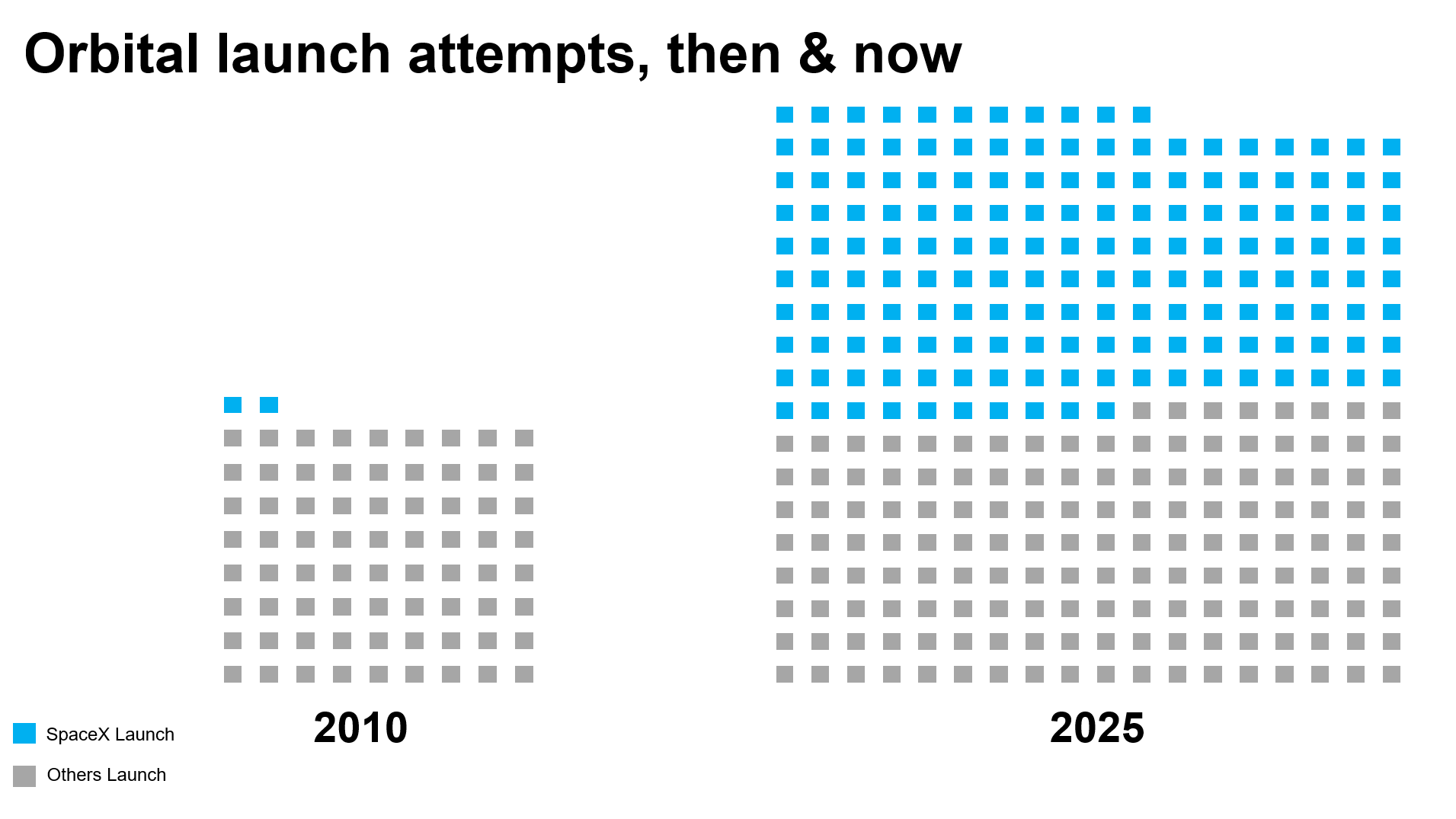
There were fewer than 80 orbital launches globally in 2010. Most were reserved for governments, defence agencies, national space programs, or large commercial operators. Dedicated small satellite launch infrastructure barely existed. Launch opportunities were infrequent, expensive, and often secondary to the priorities of much larger payloads.
In 2025, there were 317 orbital launches annually, with SpaceX alone conducting 165 launches. SpaceX alone did more than twice as many launches in a year than the entire world did in 2010. SpaceX’s latest rideshare progam via The Falcon 9 rocket carried a payload of 119 small satellites, cubesats, microsats, and orbital transfer vehicles into Low-Earth Orbit. 119.
Cost followed a similar trajectory.
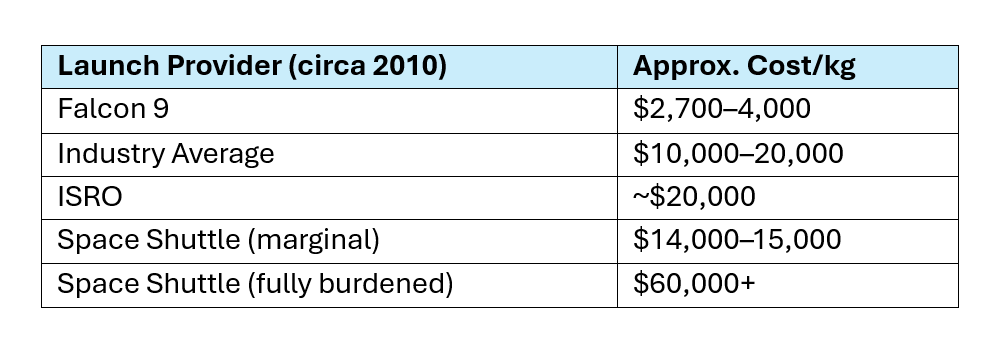
In 2010, launch economics already varied widely across providers. Traditional commercial launch services often reported ranges between $10,000 and $20,000 per kilogram, while the newly introduced SpaceX Falcon 9 was already offering materially lower pricing, reportedly in the range of $2,700 to $4,000 per kilogram to Low Earth Orbit. By comparison, ISRO’s launch services were typically quoted at approximately $20,000 per kilogram, while the Space Shuttle program operated at substantially higher costs over its lifetime. Today, SpaceX’s rideshare program offers launch services at approximately $7,000 per kg, making access to orbit affordable for startups, universities and emerging space nations. Today, operators can access published rideshare programs, standardized pricing and recurring launch opportunities through platforms such as SpaceX’s Transporter and Bandwagon missions. Like getting an Uber.
But the most important change was certainty.
In the early 2010s, a satellite operator might spend months or years searching for a suitable launch opportunity. Launch manifests changed. Payload priorities shifted. Delays often cascaded through the system. Missing a launch window could mean waiting another year.
The shift is visible in how commercial space companies now operate. SpaceX’s Transporter and Bandwagon programs have transformed launch from an occasional strategic event into a repeatable operational process. More than 1,600 payloads have reached orbit through these rideshare programs, supporting operators across Earth observation, SAR, RF intelligence, climate monitoring, communications and in-space services.
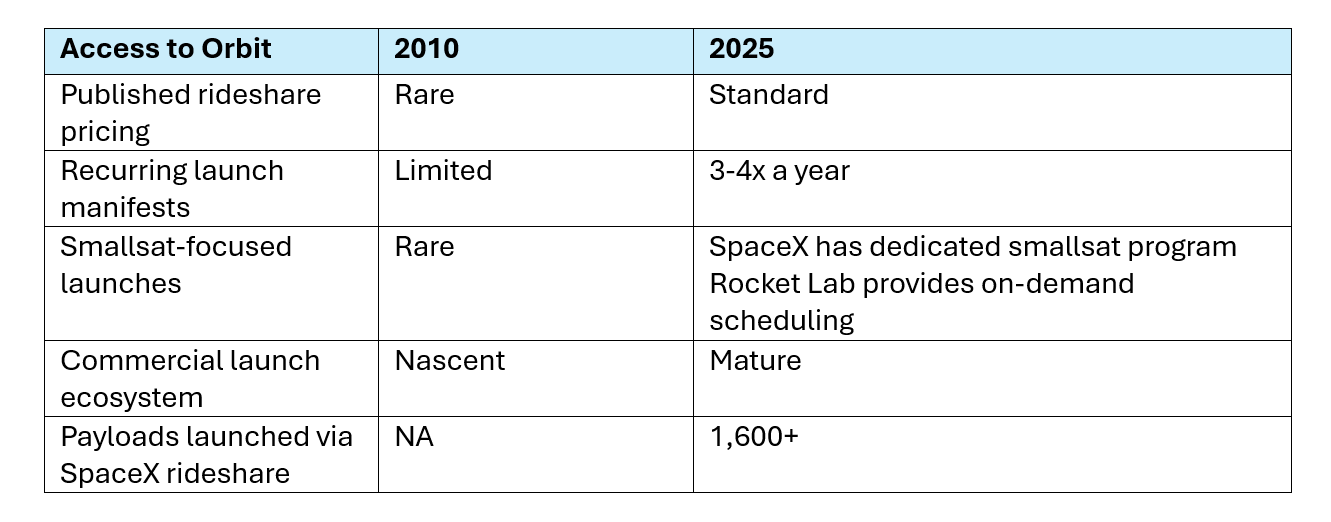
Companies such as ICEYE, Capella, Umbra, HawkEye 360 and Planet Labs increasingly deploy constellations through scheduled launch opportunities rather than bespoke procurement processes; and more than 1000 satellites have been launched by newer companies. The result is that access to orbit has become significantly more standardized, predictable and scalable than it was a decade ago.
All of this happened because launch became predictable. Investors finance predictable systems. Founders build companies on predictable systems. Markets emerge when predictable systems exist.
It will be unfair to say SpaceX created the modern space economy. Advances in electronics, software, sensors and cloud computing all mattered. What SpaceX did was remove one of the largest sources of uncertainty in the system.
For most of the space age, access to orbit was a strategic constraint. Today, it is a rideshare. That distinction proves to be SpaceX’s most important contribution.